
 Visit our High Wycombe Store
 All items in Stock in our High Wycombe Store
 01753 299 777
 Are BB Guns Toys? A Definitive Guide to UK Law
25
Sep
It’s a question we hear all the time. You’re browsing for your first airsoft gun, maybe looking for a gift for a family member, or just curious about the hobby. You see a sleek replica of a famous rifle or pistol, and the thought inevitably crosses your mind: "Is this just a toy?" It’s a simple question, but in the eyes of UK law, it has a very complex—and incredibly important—answer.
Let’s get straight to the point and clear up any confusion from the outset.
Under UK law, BB guns are not classed as toys.
This isn’t a matter of opinion or a grey area open to interpretation. It's a specific legal reality defined by several overlapping and powerful pieces of legislation. Thinking of a BB gun as a toy is the single biggest mistake a new owner can make, and it can lead to serious legal consequences. The law doesn't care if you're just "plinking" in the back garden or engaging in a competitive airsoft skirmish; it classifies these items based on their capabilities and appearance, placing them into carefully defined categories.
The correct legal terms you need to know are ‘air weapon’ and ‘imitation firearm’. Throughout this guide, we'll unpack exactly what these terms mean, why they matter, and what responsibilities they place on you as an owner. Understanding this distinction is the first and most crucial step to enjoying this fantastic hobby safely and legally.
Deconstructing the Law: What Your BB Gun Actually Is
To understand why a BB gun isn't a toy, we need to look at three key pillars of UK legislation: the laws that define what a toy is, the laws that define what a firearm is, and the laws that govern anything that looks like a firearm. It’s at the intersection of these three areas that the legal status of your BB gun is decided.
The 'Toy Story' Ends Here: Why the Law Says No
The most direct answer to our question comes from the very regulations designed to keep children safe: The Toys (Safety) Regulations 2011. These laws exist to ensure that any product "designed or intended... for use in play by children under 14 years old" meets strict safety standards. They cover everything from choking hazards and sharp edges to the chemical composition of materials, all based on the foreseeable, normal behaviour of children.
However, buried within these regulations is a specific list of items that, for legal purposes, are explicitly excluded from being considered toys, regardless of how they might be used. This list includes things like Christmas decorations, sports equipment, and, crucially for us, "Air guns and air pistols" and "Slings and catapults".
This isn't just a minor detail; it's the foundation of the entire legal framework. The exclusion is a deliberate act by legislators. It serves as a legal gateway, actively pushing these items out of the world of consumer product safety and into the far more stringent and serious domain of firearms legislation. The law recognises from the very beginning that an item designed to fire a projectile, no matter how low its power, carries a potential for harm that is fundamentally different from that of a conventional toy. It presumes a level of risk that toy safety standards are not equipped to handle. Therefore, even if a BB gun were marketed or intended for play, the law simply refuses to treat it as a toy. Its legal journey must start elsewhere—with the Firearms Act.
The Power Principle: When a BB Gun Becomes a 'Firearm'
Once an item is excluded from toy law, its next legal checkpoint is the Firearms Act 1968, a formidable piece of legislation that governs everything from sporting rifles to prohibited weapons. The Act’s starting point is to define what a 'firearm' is, and its definition is based purely on technical capability, not user intent.
Under the Act, a firearm is defined as a "lethal barrelled weapon". While that sounds intimidating, the term "lethal" has a very precise legal meaning: any weapon that can discharge a missile with a kinetic energy of more than one joule at the muzzle.
One joule is a relatively low amount of energy. For context, most airsoft replicas designed for skirmishing or serious target practice fire at between 1 and 1.3 joules to be effective at a distance. This means that almost every BB gun sold by a reputable retailer in the UK legally crosses the 1 Joule threshold. As soon as it does, it is no longer just an object; in the eyes of the law, it becomes a specific type of firearm known as an ‘air weapon’.
This principle—that legal status is determined by the objective potential for harm rather than the owner's subjective intent—is the cornerstone of UK firearms law. The 1 Joule threshold was deliberately set low to reflect the fact that even a low-powered projectile can cause serious injury, particularly to a vulnerable area like an eye. Once a BB gun crosses this line, its legal identity fundamentally changes. It doesn't matter if you only plan to shoot at tin cans; the law now treats it with the seriousness of a weapon, and a whole new set of rules comes into play.
This power principle operates on a sliding scale. While most BB guns fall into the 'air weapon' category, their legal status can escalate further if their power increases:
- Air Rifles: An air rifle (including a BB rifle) with a muzzle energy exceeding 12 foot-pounds (approximately 16.3 Joules) is classified as a Section 1 Firearm. To possess one legally, you must obtain a Firearm Certificate (FAC) from your local police force, a process that involves rigorous background checks and demonstrating a good reason for ownership.
- Air Pistols: The rules for pistols are even stricter. An air pistol (including a BB pistol) with a muzzle energy exceeding 6 foot-pounds (approximately 8.1 Joules) is classified as a prohibited weapon. It cannot be licensed with a standard FAC, and possessing one requires special authority directly from the Home Secretary, which is rarely granted.
The Appearance Test: Realistic vs. Two-Tone
If the Firearms Act governs what a BB gun does, a second major piece of legislation governs what it looks like. In the early 2000s, there was growing concern about the use of realistic-looking replica guns in crime. To the public, and even to police officers in high-stress situations, it was impossible to tell the difference between a real firearm and a harmless replica, leading to fear, armed police responses, and tragic outcomes.
In response, the government passed the Violent Crime Reduction Act 2006 (VCRA). This Act didn't replace the Firearms Act; it added another layer of regulation on top of it, creating a dual-track system based on both function and form. The VCRA introduced two new and crucial legal categories based entirely on appearance:
- Realistic Imitation Firearm (RIF): This is defined as an imitation firearm that is "so realistic as to make it indistinguishable... from a real firearm" to a layperson. The VCRA made it a criminal offence to manufacture, import, or sell a RIF.
- Imitation Firearm (IF): This is any imitation firearm that is not realistic. This is where the famous "two-tone" rule comes from.
The VCRA provided a legal solution for enthusiasts who didn't have a specific reason (or "defence") to own a realistic-looking model. For an imitation firearm to be legally considered an IF (and therefore not a restricted RIF), it must be unrealistic in its appearance. The law specifies that this can be achieved if at least 51% of the item is finished in a bright, non-military colour. The officially specified colours are bright red, orange, yellow, green, blue, pink, and purple. An item made of transparent material also qualifies as an IF.
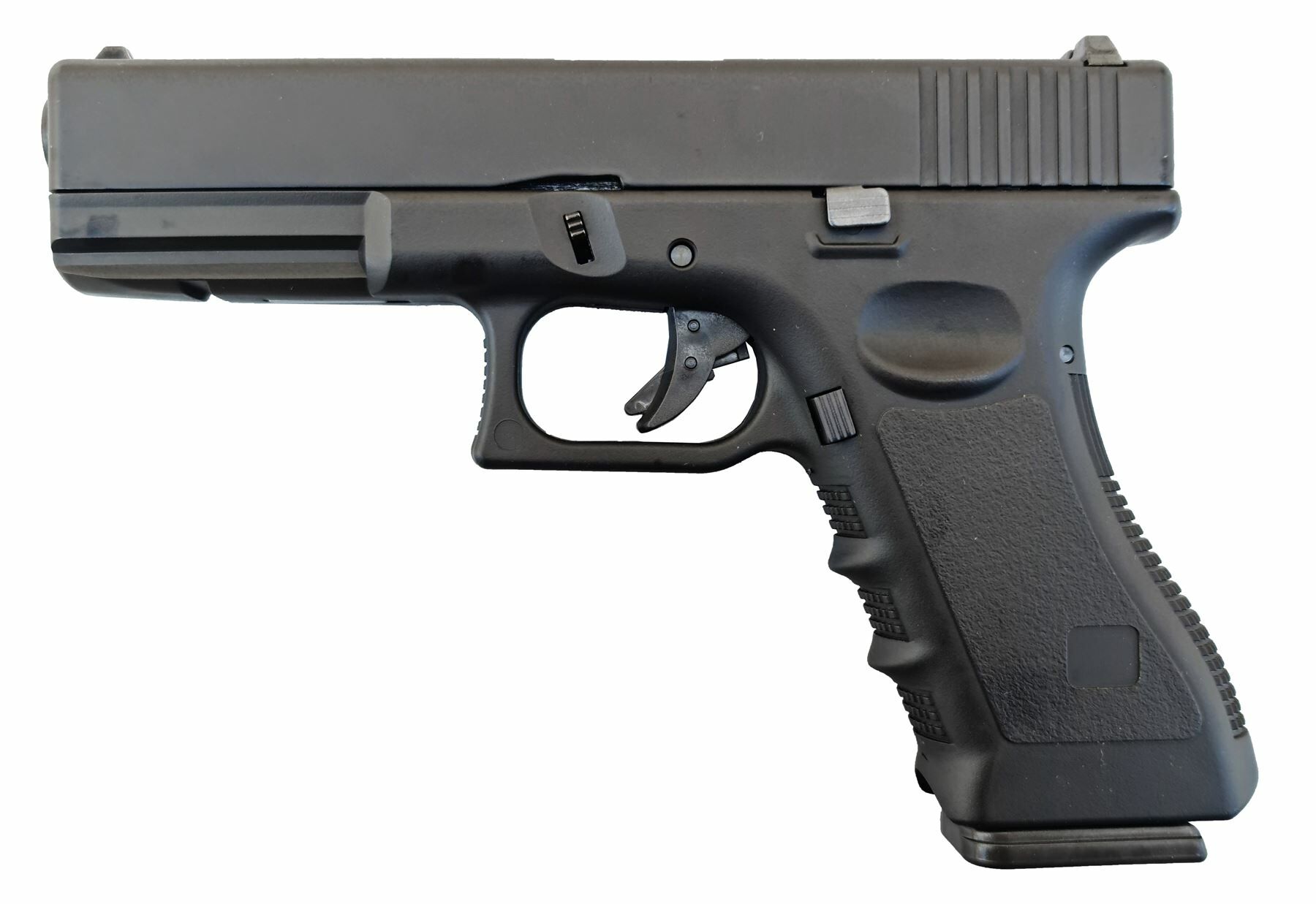 A Real Imitation Firearm (RIF)
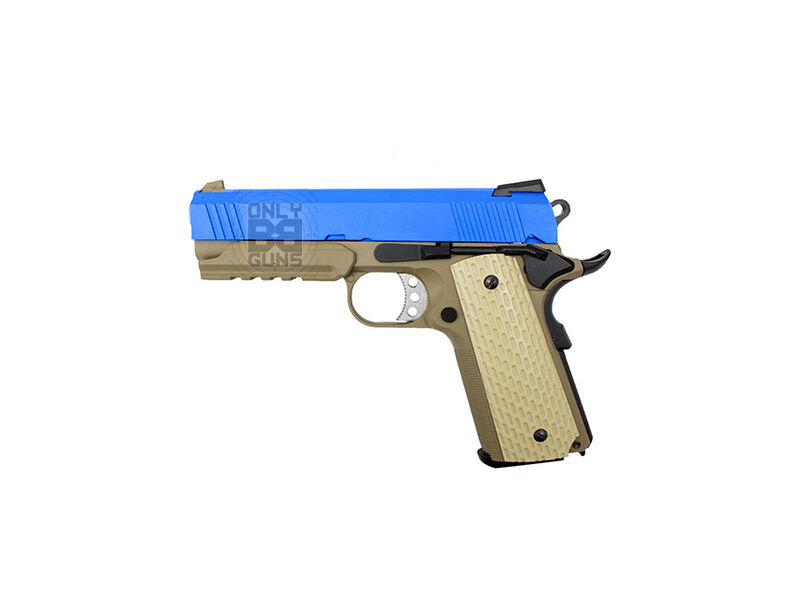 An Imitation Firearm (IF)
This distinction is legally profound. Let's walk through an example. A customer over 18 wants to buy a black M4 airsoft rifle that fires at 1.2 Joules.
- Under the Firearms Act, its power makes it an 'air weapon'.
- Under the VCRA, its appearance makes it a 'RIF'.
- To legally purchase this item, the customer must not only be over 18 but also provide a "valid defence" to the seller, proving they have a legitimate reason to own a RIF. For airsofters, the most common defence is a UKARA registration, which proves they are an active member of an insured skirmish site.
Now, imagine the same customer doesn't have a valid defence. They can still buy the exact same M4 model, provided the retailer offers a two-tone service. By professionally spraying 51% of the gun's body bright blue, the retailer is performing a legal act of reclassification. The item is still an 'air weapon' under the Firearms Act due to its power, but under the VCRA, it has been transformed from a restricted RIF into a non-restricted IF. As an IF, it can be legally sold to any member of the public, as long as they are over 18.
This is why it is a serious offence for an individual to paint their two-tone gun black. Doing so without a valid defence constitutes the illegal manufacture of a RIF. The two-tone system is not just about colour; it's a critical legal mechanism designed to provide an immediate visual signal to the public and law enforcement that the item is not a real firearm, thereby mitigating the fear and alarm it can cause.
Your Responsibilities as an Owner: A Practical Guide
Understanding the complex legal definitions is one thing; applying them in the real world is another. The law places significant responsibilities on anyone who owns, uses, or is in charge of a BB gun. These rules are strict, and ignorance is no defence.
Age is Not Just a Number: A Tiered System of Responsibility
Unlike toys, which often have simple age-suitability warnings, air weapons are governed by a legally-enforced, tiered system of responsibility that evolves as a person gets older.
- Purchasing: The law is absolute on this point. It is a criminal offence for anyone under the age of 18 to purchase or hire an air weapon or an imitation firearm. It is equally an offence for any person or business to sell one to a person under 18. There are no exceptions.
- Gifting and Ownership: The rules around gifting are nuanced. An adult over 18 can legally purchase a two-tone IF and gift it to a minor. However, the situation changes for any BB gun classified as an 'air weapon' (firing over 1 Joule). A person under 14 is legally forbidden from receiving an air weapon as a gift. In this scenario, the adult who buys the air weapon must retain legal ownership and control of it at all times.
- Rules for Use (Under 14): A person under the age of 14 may only use an air weapon on private property where they have the landowner's permission. Crucially, they must be under the direct and constant supervision of a responsible adult aged 21 or over. The term "supervision" means close, active monitoring, not simply being in the same house. The supervising adult is also held legally responsible for any offence the child commits, such as firing a pellet beyond the property boundary.
- Rules for Use (14-17): Once a person reaches 14, the law acknowledges a greater level of maturity. A 14 to 17-year-old may borrow an air weapon from someone over 18 and use it on private property (with permission) without supervision. However, they are still forbidden from buying one themselves. Furthermore, they cannot carry an air weapon in a public place unless they are supervised by someone aged 21 or over and have a good reason for doing so.
This progressive structure demonstrates how seriously the law treats these items. It establishes a "gradient of responsibility," beginning with total adult control for the youngest users, transitioning to increased personal accountability for teenagers, and culminating in full legal responsibility at the age of 18. This managed introduction to a serious responsibility is fundamentally different from the simple safety warnings found on toys.
Location, Location, Location: Where You Can Legally Shoot
The rules on where you can use your BB gun are incredibly strict and designed to protect the public and private property.
- The Golden Rule: You can only shoot an air weapon on private property where you have the explicit permission of the landowner or the person who occupies the land (e.g., a tenant). This includes your own back garden.
- The Cardinal Sin: It is a specific criminal offence for anyone, regardless of their age, to fire a missile (a BB or pellet) that travels beyond the boundary of the premises they have permission to shoot on. This law (Section 21A of the Firearms Act 1968) was introduced by the VCRA and is one of the most important rules for garden "plinkers" to understand. If your BB travels into your neighbour's garden, even by accident, you have committed a criminal offence. This is why having a suitable backstop—something that will safely stop and capture the BB—is not just good sense, it's a legal necessity.
- Other Serious Offences: There are several other location-based offences to be aware of. Trespassing on private land while carrying an air weapon elevates what would be a civil matter into a serious criminal offence of armed trespass, with severe penalties. It is also an offence to fire an air weapon within 50 feet (15 metres) of the centre of a public highway if doing so causes a road user to be injured, interrupted, or endangered.
Out and About: Transporting Your BB Gun Legally and Safely
Carrying a BB gun in public is one of the most legally hazardous things an owner can do, and it must be done with extreme care and a clear understanding of the law.
- The "Reasonable Excuse" Clause: It is an offence to have an air weapon or an imitation firearm in a public place without a "reasonable excuse". The law doesn't provide an exhaustive list of what is "reasonable," leaving it to the courts to decide on a case-by-case basis. However, generally accepted examples include travelling directly to or from an insured airsoft skirmish site, taking it to a registered firearms dealer for sale or repair, or taking it home directly from the shop where you purchased it. Simply carrying it "for protection" is not a reasonable excuse and will likely lead to prosecution.
- The Correct Method of Transport: If you have a reasonable excuse, you must transport the BB gun safely and discreetly. The law requires that it is completely concealed from public view, typically in a purpose-made, non-descript gun bag or a hard case. It must be unloaded, with the magazine removed. For extra security, the magazine should be stored separately from the gun within the case. The goal is to ensure that no member of the public is caused alarm. Brandishing an imitation firearm in public, even if you mean no harm, can cause widespread panic and is an extremely serious offence that can carry a lengthy prison sentence.
- Secure Storage at Home: Your legal responsibilities don't end when you get home. The Crime and Security Act 2010 created an offence for a person in possession of an air weapon to fail to take "reasonable precautions" to prevent anyone under 18 from gaining unauthorised access to it. This means you cannot simply leave it in a teenager's bedroom or in an unlocked shed. It should be stored securely out of sight, for example in a locked cupboard or with a trigger lock, to prevent unsupervised access by minors.
UK BB Gun Law at a Glance
The law is complex, so here is a summary table covering the most critical points for quick and easy reference.
Conclusion: Fun with Responsibility
So, are BB guns toys? The answer, unequivocally, is no. They are sophisticated items subject to serious and overlapping laws governing firearms and imitation firearms. Their legal status is determined not by how you intend to use them, but by a complex interplay of their power (function) and their appearance (form).
This might seem daunting, but these laws exist for a very good reason: to ensure public safety. They are designed both to prevent the physical injury a projectile can cause and to prevent the very real fear and alarm that realistic-looking weapons can create when seen in public. Ownership of a BB gun is therefore not just a simple purchase; it's an acceptance of a significant set of legal responsibilities.
Understanding the law isn't about spoiling the fun; it's about ensuring the sport of airsoft and the hobby of recreational shooting can thrive safely and responsibly for years to come. By knowing the rules on age, location, and transportation, you're not just protecting yourself from prosecution—you're being a great ambassador for the entire community.
So, handle with care, respect the law, and have a fantastic (and legal) time on the range.
For more information, watch this video on airsoft law:
Recent Posts
-
How UK Parents Navigate BB Gun Safety Without Legal Mistakes or Injuries: The 2025 Protection Protocol
 November 13, 2025
 -
The Ultimate Guide to Choosing Your First BB gun
 November 6, 2025
 -
Are BB Guns Toys? A Definitive Guide to UK Law
 September 25, 2025
 -
The Art of the Deal: An Expert Analysis of the 5 Best Value-for-Money BB Guns
 July 8, 2025
 -
Locked, Loaded, and Gassed Up: The Top 5 Airsoft Gas Guns at OnlyBBGuns
 May 16, 2025
FAQs
1. What is a BB gun used for? BB guns are mostly used for practice shooting and training. The stronger ones (i.e. Air Rifles) can also control pests or hunt small animals.
2. Do you need a Licence in the UK for a BB gun? No, you don't need a licence for a BB gun in the UK, but there are rules. The BB Gun needs to be in two colours; one has to be a primary. All our guns are on the website as per default.
3. Is a BB gun a good weapon? BB guns, despite sometimes being seen as toys, can be dangerous. They fire pellets at high speeds and can cause serious harm, or even be deadly in some situations.
4. Can you shoot BB guns in public in the UK without a Firearm license? BB guns in the UK navigate a legal grey area. While certain models, notably low-power 'soft air' types, typically evade classification as section 1 firearms, more potent versions may require a valid firearms certificate to avoid legal repercussions.
5. Can you shoot a BB gun in your garden? You can use a BB gun in your garden under UK law, but you have to ensure the pellets don't go into your neighbour's yard, plot or land. If they do and you don't have permission, it's against the law.
6. Which UK law am I breaking if the pellets go into my neighbour's law without permission? If your BB gun pellets go into your neighbour's yard without permission, you're breaking UK laws. Specifically, the 1968 Firearms Act and possibly the 2003 Anti-Social Behaviour Act, because you may be causing your neighbours trouble or worry.
Discover Our Top Selling BB Gun Guides
Five Best BB Guns Under £30
Discover our five top selling BB guns under £30 guide here.
Five Top Selling Gel Blasters
Discover our top selling Gel Blasters guide here.
Gas guns
Discover our Gas guns guide here.
Toy BB guns
Discover our Toy BB guns guide here.
Five Top Selling BB Guns
Discover our five top selling BB guns of 2026 guide here.
Five Top Selling BB Gun Assault Rifles
Discover our top selling BB gun assault rifles guide here.
Six Top Selling BB Gun Machine Guns
Discover our six top selling full auto BB guns (best BB machine guns to buy) guide here.
Top 6 airsoft pistols
Discover our Top 6 airsoft pistols guide here.